

By Dr. Michał Słota (Institute to Microbial Technologies, Turek, Poland)
How can biosolutions unlock stronger agricultural performance? Rovensa Next invited Michal Slota, renowned expert in plant biotechnology and human health sciences, to share his scientific perspective on one of agriculture’s most relevant topics today. Discover his analysis and key recommendations.

Why biosolutions matter now
Global crop production is entering an era in which economic resilience is becoming nearly as important as biological yield potential. Farm profitability is increasingly shaped by the interaction between climatic instability, nutrient market volatility, energy-linked fertilizer costs, geopolitical trade disruptions, and tightening sustainability constraints. Under these conditions, maximizing yield alone is an incomplete strategy; protecting the efficiency with which purchased inputs are converted into harvestable output becomes equally important.
This shift strengthens the strategic relevance of biosolutions in general, and the role of biostimulants deserves particular attention. Rather than being viewed solely as productivity enhancers, biostimulants are increasingly recognized in modern agronomy as tools for biological risk management that improve the functional efficiency and resilience of crop production systems. Through their effects on nutrient acquisition and use efficiency, stress physiology, rhizosphere functionality, and crop acclimation capacity, biostimulants can help reduce the gap between input investment and realized crop performance, particularly under variable environmental and agronomic conditions. These functions become especially valuable in fertilizer-intensive systems, where diminishing marginal returns from increasingly costly nutrient inputs can rapidly compress farm profitability.
In this broader context, biosolutions should not be understood as isolated product interventions, but as an integrated agronomic strategy encompassing biostimulation, and biocontrol products alongside input-performance optimization tools aimed at enhancing productivity, resource efficiency, and production resilience.
The economic impact of stress on crop productivity
Crop stress reduces profitability because it weakens the crop’s ability to convert purchased inputs into yield. Fertilizer, seed, crop protection, fuel and labor are often invested before the full impact of stress becomes visible. When stress disrupts photosynthesis, root activity, nutrient uptake or reproductive development, the farmer loses not only yield potential, but also input efficiency. Many stress effects occur before clear visual damage appears in the field. Reduced stomatal conductance, lower photosynthetic activity, oxidative stress, weaker nutrient transport and impaired flowering can all reduce yield formation before symptoms are obvious.
In volatile fertilizer markets, stress becomes even more expensive. If a crop cannot absorb or metabolize applied nutrients efficiently, the cost per harvested tonne increases. This is especially relevant for fertilizer-intensive crops, where fertilizer affordability has been reported as a pressure point for farmer margins.
Biostimulation strategies for supporting crop stress acclimation
To optimize farm profitability under volatile conditions, growers must shift from reactive management to proactive stress management strategies. According to established scientific and regulatory consensus, a plant biostimulant is defined as any substance or microorganism applied to plants with the purpose of enhancing nutrient use efficiency, abiotic stress tolerance and/or crop quality traits, irrespective of its nutrient content. [1]. Far from their historical positioning as peripheral or alternative agronomic inputs, plant biostimulants have evolved into a strategic component of modern crop production systems. Scientific literature increasingly recognizes biostimulants as tools capable of modulating plant metabolic and signaling pathways associated with stress adaptation, nutrient acquisition, and quality formation across diverse cropping systems.
Within these approaches, biostimulant formulations provide a diverse toolkit. Applied via seed coating, soil application, or foliar spray, these biostimulants alter crop performance through documented modes of action [Tab 1; Fig 1].
| BIOLOGICAL MODE OF ACTION | EXEMPLARY ACTIVE INGREDIENTS | |
|---|---|---|
| Triggering of specific metabolic processes | The formula acts as a biochemical signal or co-signal, shifting gene expression, enzyme activity, hormone pathways, redox status, or carbon–nitrogen metabolism | Amino acids, peptides, phosphite/phosphate-related inputs, seaweed fractions, antioxidants, phytohormone-like compounds |
| Establishment of metabolic ‘short-cuts’ | The formulation supplies ready-to-use metabolites or cofactors, reducing the plant’s energetic cost of synthesis during stress or rapid growth | Amino acids, peptides, vitamins, minerals, organic acids / carboxylic acids, osmoprotectants |
| Promotion of beneficial microbe interactions | The formula improves rhizosphere conditions or directly introduces / stimulates microbes that help nutrient acquisition, root function and stress resilience | Beneficial bacteria, mycorrhizal fungi, microbial metabolites, amino acids, protein hydrolysates, organic acids, humic substances, seaweed extracts |
| Improved nutrient availability | The formula enhances nutrient availability, uptake, transport, assimilation or nutrient-use efficiency | Humic/fulvic substances, amino acids, peptides, organic acids, seaweed extracts, microbial inoculants, silicon / trace elements, phosphites |
| Improved environmental stress tolerance | The formula primes or strengthens physiological responses to drought, salinity, heat, cold, UV, heavy metals or nutrient stress | Osmoprotectants, amino acids such as proline, betaines, antioxidants, seaweed extracts, microbial biostimulants, chitosan, phosphite, silicon/selenium / other beneficial elements |
Tab. 1 Summary of the main mode of actions of biostimulants and exemplary active ingredients present in their formulas.
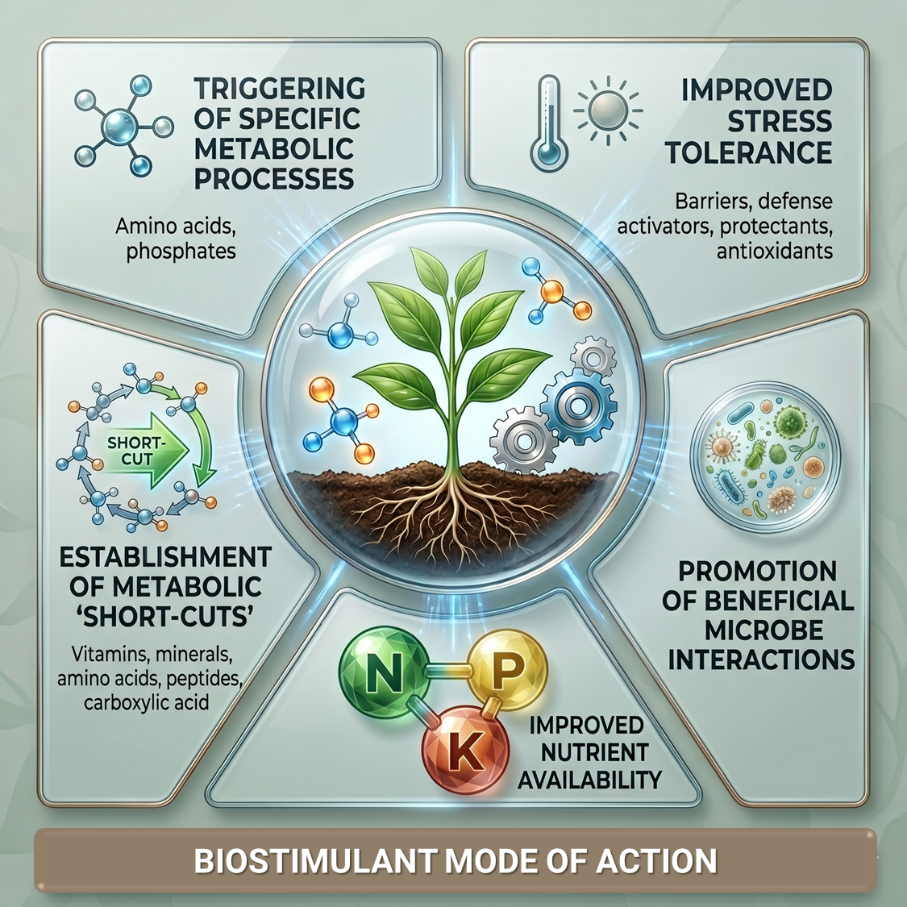
Biostimulant formulations now encompass a diverse portfolio of biological and biochemical technologies, including humic substances, protein hydrolysates, amino acids, seaweed-derived fractions, microbial inoculants, polysaccharides, osmoprotectants, botanical extracts and signaling-active metabolites.
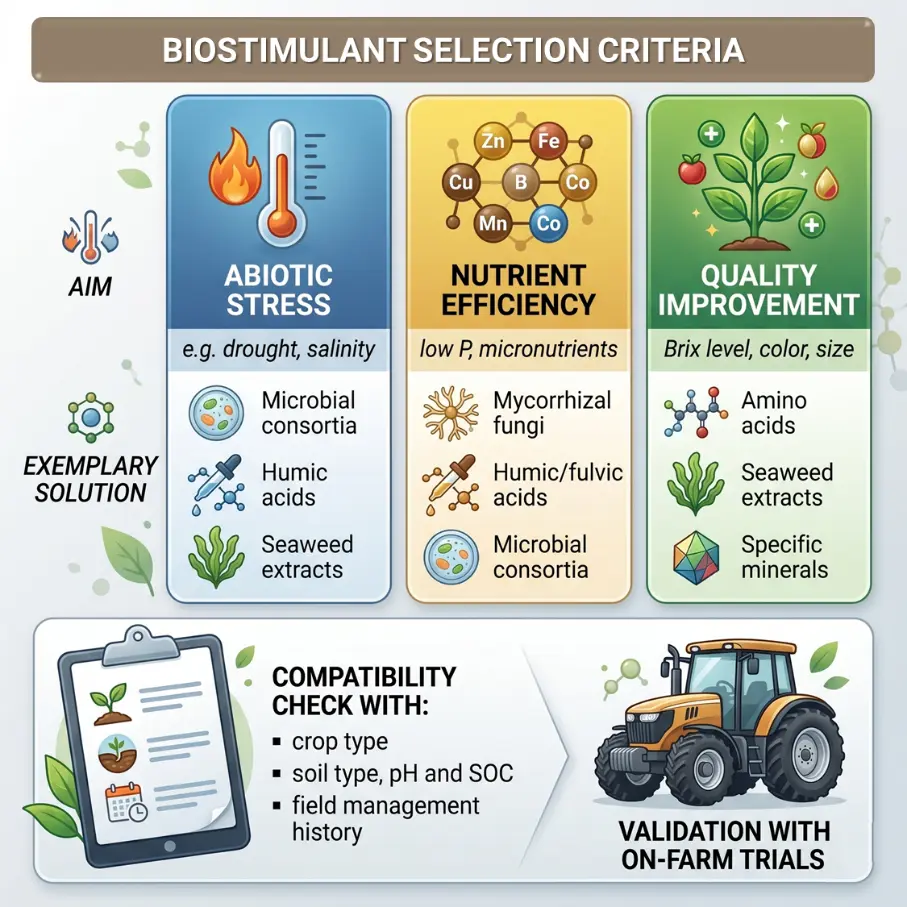
Product positioning is evolving from empirical application toward more precisely characterized biological performance technologies supported by molecular phenotyping, systems physiology and precision agronomy approaches. Selecting the right biostimulant formula should start with a clear identification of the primary agronomic goal, while also checking compatibility with the crop, soil type, pH, soil organic carbon, and field management history (Fig. 2).
Improvement of nutrient-use efficiency for balanced input management
The current fertilizer-market environment reinforces the strategic importance of nutrient-use efficiency (NUE). Fertilizer production remains tightly linked to natural gas, phosphate rock, and potassium ore, while global markets continue to be influenced by geopolitical tensions, trade restrictions, supply bottlenecks, and price volatility. Under these conditions, improving the efficiency with which crops acquire and utilize nutrients has become both an agronomic and economic priority.
Nitrogen-use efficiency remains suboptimal across many cropping systems, with only a fraction of applied fertilizer ultimately converted into harvested biomass, while substantial proportions are lost through volatilization, denitrification, leaching, and runoff [4]. Improving NUE therefore supports both farm profitability and environmental stewardship. Moreover, crop nutrient requirements are highly dynamic, shifting across developmental stages from establishment and vegetative growth to reproduction and senescence, creating temporal mismatches between nutrient availability and plant demand.
Within this context, microorganism-based biostimulants and biofertilizers emerge as increasingly relevant biosolutions for balanced input management. Through mechanisms including enhanced root architecture and soil exploration, nutrient mobilization and solubilization, biological nitrogen fixation, rhizosphere microbiome modulation, transporter activation, stress buffering, and improved nutrient assimilation, these biological tools can complement conventional fertility programs. Their strategic value may therefore lie less in substituting mineral fertilizers than in increasing the agronomic return generated by each nutrient unit applied, thereby improving input efficiency, crop resilience, and overall system performance.
From yield maximization toward resilience agronomy
Modern profitability increasingly depends not only on peak yield potential but on yield reliability across variable environments. This distinction matters commercially. A technology that moderates downside risk under drought, nutrient stress or thermal variability may generate substantial economic value even if it does not deliver exceptional yield gains under optimal seasons.
Viewed through this lens, biosolutions fit within a broader transition toward resilience agronomy — agricultural systems designed to maintain productivity despite climatic, biological and economic uncertainty.
Their future integration will likely be strongest when biosolutions are deployed as coordinated agronomic systems rather than isolated inputs, particularly when linked with:
- adaptive nutrient management,
- precision agriculture platforms,
- regenerative soil strategies,
- biocontrol programs,
- data-driven crop decision systems.
Biostimulants will not replace sound agronomy, balanced fertilization or genetics. By supporting stress acclimation, improving nutrient-use efficiency and contributing to yield stability, they can become an important profitability shield for farmers facing both environmental and economic uncertainty.
Biosolutionize Agriculture: Integrated biosolutions strategies driving efficiency, profitability and sustainable crop performance
Following Michal Slota’s analysis, at Rovensa Next we conclude that today’s agricultural challenges require more than isolated products; they demand integrated crop nutrition strategies that combine efficiency, productivity, resilience, and sustainability. This is where our agronomic expertise comes into play, helping to optimize fertilization programs, improve nutrient use efficiency (NUE), reduce input losses, and protect both yield and profitability.
Through our Biosolutionize Agriculture approach, we go beyond individual solutions by integrating biosolutions with modern fertilization strategies to support growers in building more efficient, resilient, and sustainable farming systems for the future. Biosolutionize Agriculture is much more than a concept; it is a strategic commitment and a campaign that provides science-backed answers to today’s farming challenges. Its integrated strategies are designed to help growers mitigate abiotic stress, improve soil health and vitality, enhance water use efficiency, boost crop quality and resilience, optimize agricultural inputs, preserve beneficial insect populations, manage pests and diseases effectively, and support resistance management.

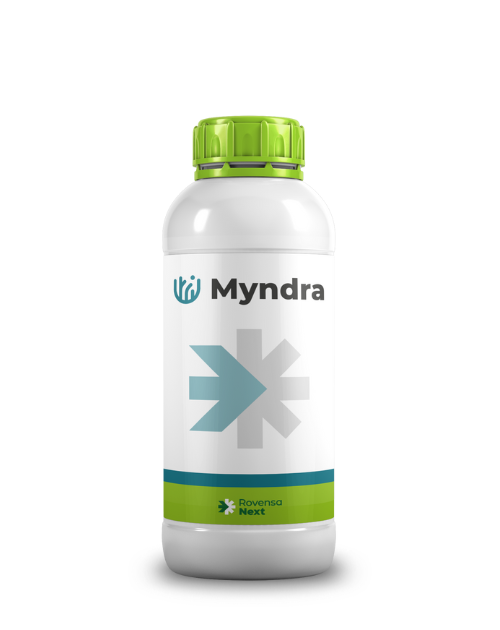
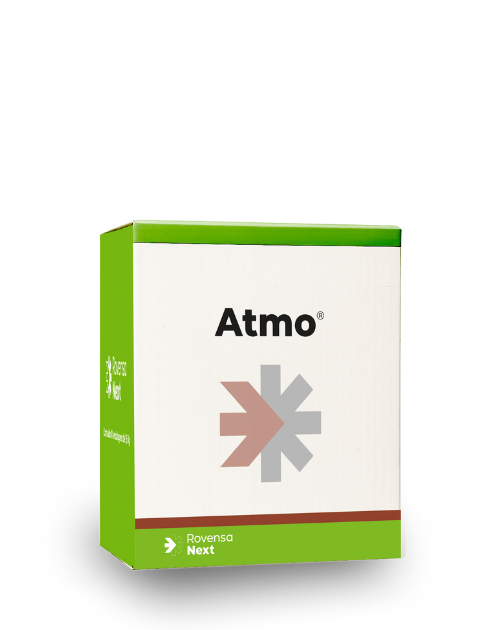
A clear example of this approach is the role of biosolutions in supporting plant physiology, nutrient use efficiency and crop quality under increasingly variable growing conditions. The Rovensa Next portfolio includes solutions such as the Phylgreen range, based on its Primactive effect technology to improve abiotic stress tolerance and maintain photosynthetic activity under drought, heat, and salinity stress, alongside Delfan with its Curactive effect, an amino acid technology designed to support metabolic recovery, nutrient assimilation and crop performance during periods of high physiological demand. Complementary solutions, including Barrier, Rootex, and Frutex, help reinforce plant resilience, root development, flowering, and fruit quality. Quality-oriented biosolutions such as Biimore and Myndra are designed to enhance crop quality parameters, uniformity and marketable yield by improving plants’ metabolic activity and nutrient management. In addition, biofertilizer technologies including Otimais Duo, Phos’Up, Atmo and Azzofix contribute to improved nitrogen fixation, phosphorus availability and nutrient use efficiency within integrated fertility programs.
 |
 |
 |
 |
 |
 |
Field evaluations have shown that these biosolutions can improve nutrient assimilation by 10–25%, strengthen crop resilience under abiotic stress conditions and support more stable yields and crop quality in challenging environments.